
Learning Center
How Pet Hair Gets Into Your Ductwork 101
Learn how pet hair gets into your ductwork through return vents & low-efficiency filters. Ohio pet owners: spot signs & schedule NADCA-certified cleaning!
By Bachar “Ben” El Halabi Published
Why Understanding How Pet Hair Gets Into Your Ductwork Can Save Your HVAC System
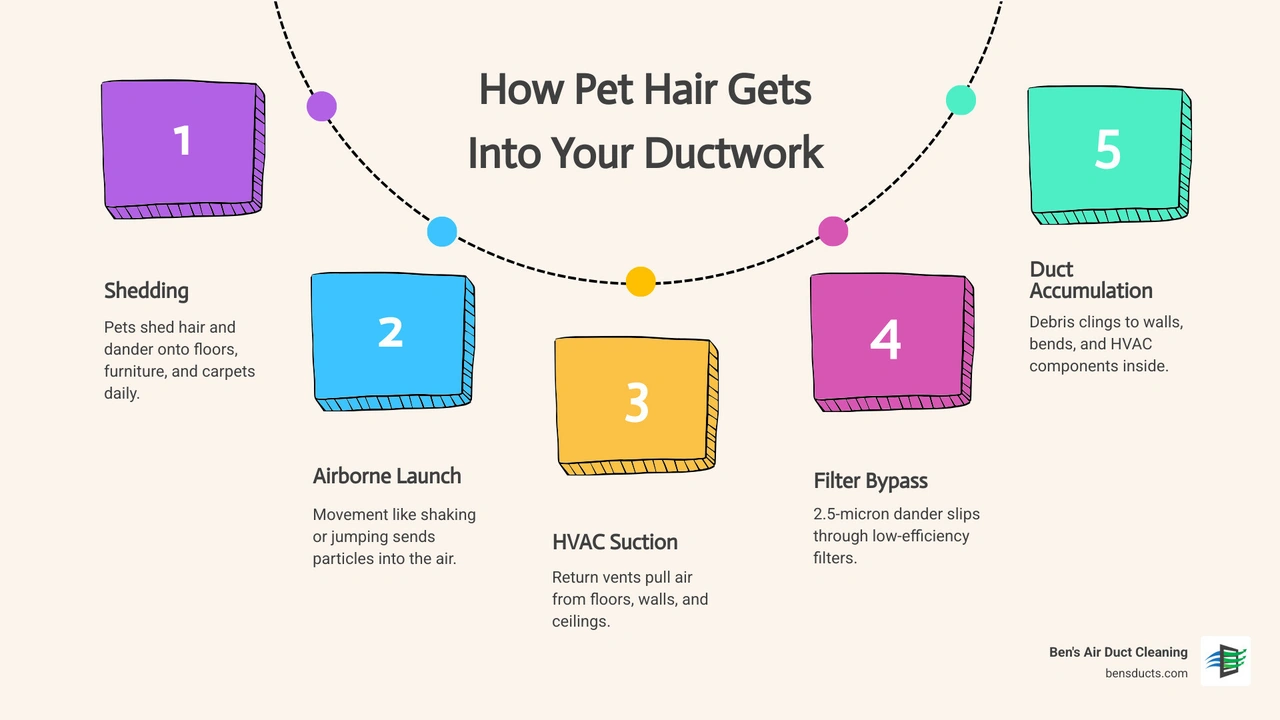
How pet hair gets into your ductwork is simpler than most pet owners realize — and it happens every single time your heating or cooling system kicks on.
Here is a quick breakdown:
- Your pet sheds hair and microscopic skin flakes (dander) onto floors, furniture, and carpets.
- Everyday activity — a dog shaking off, a cat jumping down from the couch — launches those particles into the air.
- Your HVAC system pulls air through return vents located in floors, walls, or ceilings throughout your home.
- Pet hair and dander ride that airflow directly into the return grilles.
- Low-efficiency filters miss the smallest particles — pet dander can be as small as 2.5 microns, small enough to slip right through.
- Hair and dander settle deep inside the ductwork, clinging to duct walls, bends, and HVAC components where normal cleaning can't reach.
For Ohio homeowners — especially those in the Cleveland area — this is not just an air quality concern. It is a year-round HVAC issue. When pets are part of the family, the amount of airborne debris that winds up inside ducts can be roughly twice as much as in a pet-free home. And once that buildup takes hold, it circulates allergens, strains your system, and can even create persistent odors that no amount of surface cleaning will fix.
The good news? Once you understand exactly how pet hair travels from your pet's coat to your furnace, you can take smart steps to slow it down — and know when it is time to call in professionals to clear it out.
Learn more about how pet hair gets into your ductwork:
The Mechanics of How Pet Hair Gets Into Your Ductwork
To solve the problem of fur-filled vents, we first have to look at the physics of your home’s airflow. Your HVAC system is essentially the lungs of your house. It breathes in air from your rooms, conditions it (heats or cools it), and breathes it back out. This "inhalation" happens through the return air grilles.
These grilles are designed to pull in large volumes of air to keep the pressure balanced. Unfortunately, they don't just pull in air; they pull in everything floating in that air. In a home with pets, this includes a constant stream of airborne dander and fur. While you might see the occasional "tumbleweed" of golden retriever fur rolling across the hardwood in your Westlake living room, it’s the invisible stuff that does the most damage.
Pet dander consists of microscopic skin flakes. These particles are incredibly light and can remain airborne for hours. When your furnace or air conditioner is running, the suction force at the return vents acts like a giant vacuum cleaner, pulling these skin flakes and loose hairs directly into the system. This is the primary way how pet hair gets into your ductwork.
How pet hair gets into your ductwork through return vents
The location of your vents plays a huge role in how much hair ends up in the system. Floor registers are particularly vulnerable. Gravity is a relentless force; as your pets shed, the hair naturally settles toward the floor. If you have a heavy-shedding breed like a Siberian Husky or a German Shepherd, they often seek out the cool metal of a floor vent to lie on during a humid Ohio summer.
When a pet lounges directly on or near a return vent, the suction velocity pulls loose fur straight from the source. Over time, this creates thick fur mats that can partially obstruct the grille. Even if the hair doesn't make it past the vent cover immediately, the constant airflow breaks the hair down into smaller fragments that eventually get sucked into the dark recesses of your ducts. In multi-pet households, we often see measurable debris accumulation in these return paths in as little as 12 to 18 months.
Why low-efficiency filters can’t stop how pet hair gets into your ductwork
Many homeowners believe their standard air filter is a "brick wall" for pet hair. Unfortunately, that’s rarely the case. Air filters are rated by the Minimum Efficiency Reporting Value (MERV). Standard, low-cost fiberglass filters (usually MERV 1-4) are designed to catch large "boulders" of dust to protect the furnace motor, but they do almost nothing to stop pet dander.
Pet dander particles are typically 2.5 microns or smaller. To put that in perspective, a human hair is about 70 microns wide. Dander is roughly 28 times smaller than a human hair! These tiny particles easily bypass lower-efficiency filters. Furthermore, if a filter is even slightly the wrong size or has gaps in the housing, the air (and the hair) will take the path of least resistance, flowing right around the filter and deep into your supply ducts.
| Feature | MERV 8 Filter | MERV 11 Filter |
|---|---|---|
| Pet Hair Capture | Good | Excellent |
| Dander Capture | Moderate (traps large dander) | High (traps microscopic particles) |
| Airflow Impact | Minimal | Moderate (requires monthly checks) |
| Best For | Single-pet homes | Multi-pet/Allergy households |
| Replacement Frequency | Every 60 days | Every 30-45 days |
Signs Your Ohio Home Has Pet Hair Buildup
Living in Northeast Ohio, from Cleveland to Strongsville, we spend a lot of time indoors with our windows shut against the lake effect snow or the summer humidity. This means we are breathing recirculated air. If you aren't sure if your ducts are due for a cleaning, look for these tell-tale signs:
- Visible Fur at the Grilles: If you see "beards" of hair hanging from your ceiling vents or thick mats inside your floor registers, the internal ductwork is likely much worse.
- The "Wet Dog" Smell: Do you notice a musty, organic odor every time the AC kicks on? As pet hair and dander sit in your ducts, they can trap moisture. This leads to the breakdown of proteins in the hair, creating persistent odors that can't be fixed with candles or sprays.
- Rapid Dust Return: If you dust your coffee table in Lakewood and see a fine layer of gray fuzz back on it by the next morning, your HVAC system is likely spitting pet debris back into your living space.
- Allergy Flare-ups: If family members are sneezing more often or experiencing itchy eyes only when they are inside the house, it’s a sign that air ducts and pet dander impact your health.
- Weak Airflow: When pet hair clogs the internal components (like the blower fan or the evaporator coil), the system has to work harder to push air through. If some rooms feel warmer than others, a "fur clog" might be the culprit.
Why Pet Hair in Ducts is a Problem for Your HVAC System
It isn't just about the "ick" factor; how pet hair gets into your ductwork directly impacts your wallet. Your HVAC system is a precision-tuned machine. When pet debris infiltrates the mechanical sections, it causes a chain reaction of efficiency loss.
- Blower Motor Strain: The blower fan is responsible for moving air. When hair wraps around the fan blades or the motor shaft, it creates "drag." This forces the motor to use more electricity to maintain the same speed, leading to higher energy bills and eventual motor failure.
- Evaporator Coil Blockage: In the summer, your AC’s evaporator coil is cold and often slightly damp with condensation. Pet dander and hair stick to this wet surface like glue. This creates a blanket of insulation over the coils, preventing them from cooling the air effectively. This is a leading cause of frozen AC units in the Berea and North Olmsted areas.
- Heat Exchanger Risks: In the winter, hair that makes it to the heat exchanger can singe, creating a burning smell and potentially damaging the component.
- Reduced Lifespan: An HVAC system choked by pet hair may have its lifespan shortened by several years because it is constantly running at 110% capacity just to keep up with your thermostat settings.
Proactive Habits to Keep Your Vents Clean
While you can't stop your pets from being pets, you can significantly reduce the amount of debris that enters your system. Think of it as a multi-layered defense strategy.
Grooming is Your First Line of DefenseThe less hair on the dog, the less hair in the duct. We recommend brushing your pets daily, and if the weather in Avon or Westlake permits, do it outdoors! This keeps the "launch" of dander outside your home’s envelope. Regular professional grooming for long-haired breeds can also reduce the volume of shedding by up to 80%.
Vacuum with PurposeNot all vacuums are created equal. If you have pets, a HEPA-filter vacuum is a non-negotiable tool. Standard vacuums often suck up hair but blow microscopic dander right back out of the exhaust and into the air—where your return vents are waiting to catch it. Vacuum high-traffic areas and the spaces around your return registers at least twice a week.
The 30-Day Filter RuleIn a pet-free home, you might get away with changing a filter every three months. In a home with two cats and a Lab in North Royalton? You should be checking that filter every 30 days. When a filter becomes "loaded" with hair, the pressure from the fan can actually pull the edges of the filter inward, allowing unfiltered air to bypass the system entirely. For more tips, check out our pet owners guide to cleaner indoor air.
Frequently Asked Questions about Pet Hair in Ducts
How often should pet owners in Cleveland schedule duct cleaning?
For a typical home, the National Air Duct Cleaners Association (NADCA) suggests cleaning every 3 to 5 years. However, for pet owners in the Cleveland area, we generally recommend a 2 to 3-year interval. If you have multiple heavy-shedding breeds (like Huskies or Labs) or family members with severe asthma, you might even consider an inspection every 18 to 24 months. The "lake effect" humidity in our region can make pet dander stickier, leading to faster buildup than in drier climates.
Can I use DIY methods to remove pet hair from my vents?
You can certainly handle some surface maintenance! Taking a vacuum hose to your register covers and reaching a few inches into the duct is a great weekly habit. However, a household vacuum lacks the "negative pressure" required to pull debris from the deep turns and plenums of your system.
Professional cleaning involves high-powered, truck-mounted vacuums and specialized "air whips" that dislodge hair stuck to the walls of the ducts. DIY methods often just push the hair further back or stir it up into the air, which can actually make your indoor air quality worse in the short term.
Does duct cleaning remove persistent pet odors?
Yes, but it’s a two-step process. First, we perform "source removal," which means physically extracting every bit of hair, dander, and dust. However, pet dander leaves behind sticky protein residues (like Fel d 1 from cats) that can cling to the duct walls even after the visible dust is gone.
In these cases, we recommend an EPA-registered antimicrobial sanitization treatment after the cleaning. This neutralizes the proteins and bacteria that cause odors, leaving your home smelling fresh rather than just "less dusty."
Conclusion
At Ben's Air Duct Cleaning, we love our furry neighbors as much as you do, but we also know the toll they take on your home’s infrastructure. From the historic homes in Lakewood to the newer builds in Avon Lake and Solon, how pet hair gets into your ductwork is a universal challenge for Ohio homeowners.
Don't let your HVAC system struggle under the weight of years of accumulated fur. Our NADCA-certified experts use advanced source-removal technology to ensure your ducts are truly clean, helping your system run more efficiently and your family breathe easier. Whether you are in Cleveland, North Royalton, or anywhere in our Northeast Ohio service area, we are here to help.
Is your HVAC system ready for pet season? Schedule professional duct cleaning to remove pet dander today and give your home the fresh start it deserves.
Free quotes · 4.9★ on Google
Breathe easier. Get your free quote today.
Call now or request a free quote online — the Ben's team serves Northeast Ohio with licensed, insured, background-checked technicians.
No-pressure pricing · Before & after photos every job · 36 Ohio cities