
Learning Center
Cheat Sheet to Air Duct Cleaning for Homes with Pets
Discover how air duct cleaning for homes with pets removes dander, odors, and allergens while restoring HVAC airflow and improving indoor air quality.
By Bachar “Ben” El Halabi Published
Why Pet Owners Need to Think About Their Air Ducts
Air duct cleaning for homes with pets is one of the most overlooked steps in keeping your family healthy — and your HVAC system running the way it should.
Here is a quick summary of what pet owners need to know:
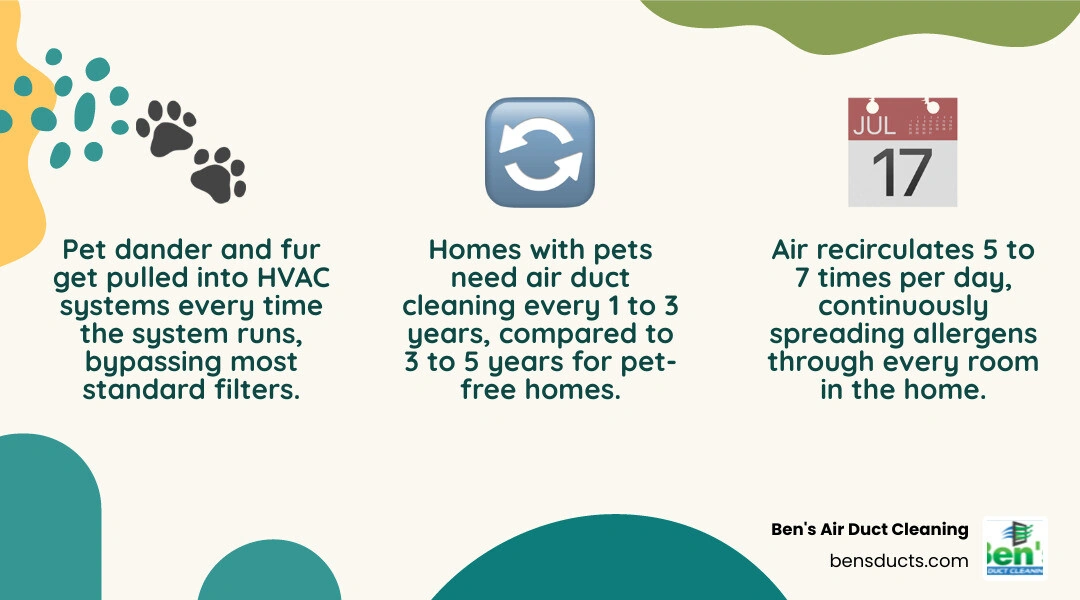
- Pets shed constantly. Dander, fur, and saliva proteins get pulled into your HVAC system every time it runs.
- Standard filters miss most of it. A basic MERV 8 filter may only catch around 10% of airborne pet dander.
- Your system recirculates air 5 to 7 times per day. That means allergens make the rounds through your home continuously.
- Pet households need more frequent cleaning. NADCA recommends every 1 to 3 years for homes with pets, compared to 3 to 5 years for pet-free homes.
- Professional cleaning removes what filters cannot. Up to 40 pounds of hidden debris — including pet hair and dander — can build up inside the average home's ductwork.
If you share your home with dogs, cats, or other furry companions, you already know that pet hair shows up everywhere. What you might not realize is that your air ducts are quietly collecting it too — along with microscopic dander particles that stay airborne for hours and bypass your filter with ease.
Every time your furnace or air conditioner kicks on, that buildup gets redistributed through every room in the house. You can vacuum the floors, wash the pet bedding, and still find yourself sneezing — because the source of the problem is hidden inside your ductwork, not sitting on your couch.
This guide from Ben's Air Duct Cleaning walks Ohio homeowners through everything you need to know: how pet dander behaves inside an HVAC system, what warning signs to watch for, how often to schedule cleaning, and what to look for in a qualified local provider.
Air duct cleaning for homes with pets word roundup:
How Furry Friends Impact Your Home's Ventilation System

Your heating and cooling system is the respiratory system of your home. It draws air in, conditions it, and pushes it back out. If you have pets, that air is heavily loaded with biological material.
Every time your dog shakes off after a walk or your cat leaps onto the windowsill, they release thousands of microscopic particles. Because your HVAC system circulates the air in your home 5 to 7 times every single day, your return grilles act like giant vacuums. They pull in loose fur, dust, and airborne dander directly from your living spaces.
Once inside, this material travels through your return lines. While a portion of the heavier pet hair is caught by your furnace filter, a massive amount of lighter debris bypasses the filter entirely. Over time, this creates thick, felt-like mats of hair and dust at duct junctions, register connections, and bends. To understand more about how these particles migrate, you can read about Ductwork Indoor Air Pollution Sources.
The Science of Pet Dander and Why It Sticks
To understand why pet dander is so troublesome, we have to look at its physical properties. Pet dander consists of microscopic skin flakes shed by animals with fur or feathers. These particles are incredibly small, typically ranging from 1 to 10 microns in diameter. For perspective, a single human hair is about 70 microns wide.
Because they are so small and lightweight, dander particles can remain suspended in the air for hours. They do not simply fall to the floor where your vacuum can reach them; instead, they float on gentle air currents directly into your return vents.
Furthermore, pet dander is not just dry skin. It is coated in highly adhesive proteins found in your pet's saliva and urine (such as Fel d 1 in cats and Can f 1 in dogs) which they transfer to their fur during grooming. When these sticky proteins enter your ventilation system, they bind to the metal and flexible plastic walls of your ductwork.
Corrugated flex ducts are especially prone to trapping this sticky dander because of their ridged interior surfaces. Once the dander adheres, it acts like a magnet for other passing dust, pollen, and hair. To dive deeper into this process, check out our article on Air Ducts Pet Dander Impact.
Signs Your HVAC System is Struggling with Pet Contamination
How do you know if your furry friends are overwhelming your heating and cooling system? Here are the most common warning signs:
- The Dust Rebound: You thoroughly dust your living room in Lakewood or Westlake, only to find a fresh layer of gray film on your tables and TV screen just 24 hours later.
- Ghosting Around Vents: You notice dark, greasy smudges or "ghosting" streaks on the walls or ceilings immediately surrounding your supply registers. This is caused by sticky, dander-laden dust blowing out of the vents and adhering to the paint.
- Musty, Stale Odors: When the furnace or air conditioner turns on, a distinct pet odor fills the air. Even after professional carpet cleaning, this smell persists because the organic oils and bacteria are trapped inside the dark, warm environment of your ducts.
- Frequent Filter Clogging: Your furnace filter is completely matted with fur and gray dust within 30 days, rather than lasting the standard 60 to 90 days.
- Uneven Airflow: Some rooms feel noticeably warmer or cooler than others because thick clumps of hair have restricted the airflow through specific duct branches.
Ignoring these issues does more than just make your housekeeping harder. To learn about the long-term consequences, read about How Dirty Air Ducts Affect Your Health.
The Real Benefits of Air Duct Cleaning for Homes with Pets
For households with pets, scheduling professional duct cleaning is not just about keeping a clean home — it is about restoring the balance of your entire indoor environment.
When we perform a professional cleaning, we don't just vacuum the registers. We clear out the entire system, which can hold up to 40 pounds of accumulated dust, dirt, dander, and hair. Removing this heavy biological load offers two major benefits: immediate relief from airborne allergens and a significant boost in your HVAC system's operating efficiency.
When your ductwork is clean, your furnace and air conditioner do not have to work nearly as hard to push air through the system. This reduces wear and tear on sensitive components like the blower motor and evaporator coils, helping to prevent unexpected breakdowns during hot Ohio summers or freezing winters. For more details on this process, see how to Eliminate Allergens Trapped in Air Ducts.
Health Risks of Neglected Ductwork for Allergy Sufferers
Living with dirty ducts can take a serious toll on your family's physical well-being, particularly if anyone in your home suffers from allergies or respiratory conditions.
According to the National Institutes of Health (NIH), roughly 84% of U.S. homes have detectable dust mite levels. Why does this matter to pet owners? Because microscopic pet dander is one of the primary food sources that keeps dust mite colonies thriving. When dander accumulates inside your dark, warm ductwork, it creates a perfect breeding ground for both dust mites and mold.
When the HVAC system cycles on, it blows these allergens directly into your breathing zone. For allergy and asthma sufferers, this constant exposure can lead to chronic symptoms, including:
- Persistent sneezing and nasal congestion
- Itchy, watery, or bloodshot eyes
- Scratchy throats and dry coughs
- Wheezing, chest tightness, and difficulty breathing
- Skin irritation and eczema flare-ups
To explore the connection between your home's ventilation and respiratory health, read our guide on Air Duct Cleaning for Allergy and Asthma Sufferers.
Restoring Airflow and Eliminating Lingering Pet Odors
Have you ever wondered why your home still smells like "dog" or "cat" even after you have scrubbed the floors, washed the curtains, and steam-cleaned the carpets? The answer lies in your HVAC system.
Pets naturally produce skin oils and saliva proteins that carry distinct odors. As these biological materials are pulled into your system, they settle onto the internal surfaces of your ductwork. If your ducts have porous fiberglass liner or insulation, these materials act like giant sponges, absorbing and trapping odors over years of operation.
Standard air fresheners and scented candles only mask these smells temporarily. The only way to permanently eliminate lingering pet odors is to physically remove the organic debris that causes them.
Professional cleaning strips away the layers of hair, dander, and oil. Following up the mechanical cleaning with an EPA-registered, pet-safe sanitizing treatment neutralizes the biological proteins at the molecular level, restoring a truly fresh smell to your home. You can learn more about managing these hidden odors by visiting our section on Indoor Air Quality.
Maintenance Guidelines and Cleaning Frequency
Keeping your indoor air clean is a team effort. While professional cleaning provides a comprehensive reset, daily and weekly habits help prevent rapid dander buildup in your system.
Here is a practical checklist of daily and weekly habits to keep your air fresh:
- Groom Pets Outdoors: Whenever possible, brush your dogs or cats outside or in a contained space like a bathroom to prevent loose fur from floating directly toward your return vents.
- Wash Bedding Weekly: Wash pet beds, blankets, and favorite throw rugs weekly in hot water (at least 130°F) to kill dust mites and break down sticky saliva proteins.
- Vacuum with HEPA Filtration: Use a vacuum cleaner equipped with a True HEPA filter at least twice a week. Standard vacuums without HEPA filters often blow fine dander particles back out into your room's air.
- Wipe Down Hard Surfaces: Regularly wipe counters, window sills, and baseboards with a damp microfiber cloth to capture settled dander before it can be kicked back into the air.
- Keep Vents Clear: Ensure your pet’s favorite sleeping spot or bed is not blocking a return air grille, which can choke your HVAC system and force it to draw in concentrated dander.
For a complete breakdown of proactive strategies, explore our Pet Owners Guide to Cleaner Indoor Air.
How Often to Schedule Air Duct Cleaning for Homes with Pets
While standard, pet-free homes can comfortably go 3 to 5 years between professional duct cleanings, pet households require a more frequent schedule. The exact frequency depends on how many animals you have, how much they shed, and whether anyone in your home suffers from allergies.
The table below outlines our recommended cleaning frequencies based on your household's biological load:
| Household Type | Shedding Level | Allergy Sensitivity | Recommended Cleaning Frequency |
|---|---|---|---|
| No Pets | None | Low / Standard | Every 3 to 5 Years |
| 1 Pet (Short-haired / Low-shedding) | Low | Low / Standard | Every 2 to 3 Years |
| 1-2 Pets (Moderate shedding) | Moderate | Standard | Every 2 Years |
| 2+ Pets or Heavy-Shedding Breeds (e.g., Golden Retrievers, German Shepherds, Huskies) | High | Standard / Moderate | Every 1 to 2 Years |
| Multiple Pets & Allergy Sufferers | High | High (Asthma / Severe Allergies) | Every 12 to 18 Months |
Choosing the Right Service Provider in Ohio
When it comes to air duct cleaning for homes with pets, who you hire matters just as much as how often you clean. The market is filled with companies offering quick, cheap cleanings that often do more harm than good.
For homeowners in the Cleveland suburbs — from Avon Lake and Westlake to Parma, Strongsville, and Lakewood — choosing a local specialist who understands the unique challenges of pet-friendly homes is essential. For additional ideas on local home care, read about the Best Ways to Manage Pet Allergens Indoors.
Professional vs. DIY Air Duct Cleaning for Homes with Pets
It can be tempting to buy a cheap brush kit online, attach it to a household shop vacuum, and try to clean your own vents. However, DIY duct cleaning is highly discouraged, especially in pet homes.
Standard household vacuums lack the negative static pressure required to safely extract pet hair and dander through long, winding duct runs. A DIY vacuum will typically stir up the settled dust and dander, sending it airborne throughout your home and making your indoor air quality significantly worse.
Furthermore, household vacuums do not have the capacity to pull dense mats of pet hair out of your system. Instead, DIY brushes often push these clumps deeper into the ductwork, where they can get lodged against your expensive air conditioning evaporator coils or blower motor, leading to costly system damage.
Professional cleaning relies on truck-mounted negative air machines that pull thousands of cubic feet of air per minute, ensuring that 99.97% of all dislodged particles are safely extracted directly out of your home and into HEPA-filtered collection bags.
What to Look For in a Local Duct Cleaning Specialist
To protect your home and ensure a thorough job, look for a service provider that meets these professional standards:
- NADCA Certification: Always verify that the company is certified by the National Air Duct Cleaners Association (NADCA). This ensures they follow strict industry standards for source removal.
- W2 Technicians: Choose a company that employs trained, background-checked W2 employees in branded company uniforms, rather than hiring third-party subcontractors.
- Thorough, Full-System Cleaning: A proper job includes cleaning all supply and return ducts, registers, grilles, the blower motor, the plenum, and the drain pans. Beware of "blow and go" companies that only clean the visible vents.
- Before-and-After Photographic Proof: A reputable local specialist will always provide photographic evidence of their work inside your ducts, showing you exactly what was removed.
- Avoid Ultra-Low Specials: Avoid companies advertising "$99 whole-house" specials. These are almost always bait-and-switch operations designed to get through your door and upsell you on expensive, unnecessary services.
Frequently Asked Questions about Pet Dander and HVAC Systems
Does the EPA recommend air duct cleaning for homes with pets?
The U.S. Environmental Protection Agency (EPA) does not recommend routine air duct cleaning for every home. Instead, the EPA suggests cleaning your air ducts on an "as-needed" basis when specific conditions exist.
For pet owners, these conditions often include visible accumulations of dust, hair, and debris inside the registers, or when family members experience unexplained allergy symptoms indoors. Because pet hair and sticky dander accumulate much faster than standard household dust, pet homes reach these "as-needed" thresholds much sooner than pet-free households.
Can pet hair in vents cause a fire hazard?
While pet hair inside your heating and cooling ducts can restrict airflow and strain your furnace motor, it is rarely a direct fire hazard inside the metal ductwork itself.
However, pet hair is a major fire hazard when it enters your dryer vents. Pet hair clings to clothing and easily bypasses your dryer's lint screen. Over time, it mixes with clothing lint to form highly flammable clogs inside your dryer exhaust line. This is why we highly recommend that pet owners have their dryer vents cleaned at the same time as their air ducts.
Why does my house still smell like pets after cleaning the carpets?
This is a common frustration for pet owners. Carpets certainly hold odors, but your HVAC system acts as a giant loop.
When your pets rest on the floor, their skin oils, dander, and shed hair are drawn directly into the low-profile return vents near the floor. These biological residues settle inside the dark, warm interior of your ductwork, especially on any porous insulation liners.
Every time your HVAC fan turns on, it blows air across these smelly deposits, distributing the odor throughout your entire home. Until you physically remove this organic buildup from your ductwork, the smell will persist.
Conclusion
Sharing your life with pets brings immense joy, but it also brings unique challenges for your home’s indoor air quality.
By prioritizing regular, professional duct cleaning, you can protect your family from irritating allergens, eliminate stubborn pet odors, and keep your heating and cooling system running efficiently for years to come.
If you are ready to breathe easier, contact the expert team at Ben's Air Duct Cleaning. We serve homeowners across Northeast Ohio — including Berea, Cleveland, Avon, Westlake, Strongsville, and surrounding suburbs — with honest, certified, and thorough service.
To take the first step toward a cleaner, healthier home, read more about how we address Air Ducts Pet Dander Impact and schedule your professional home inspection today.
Free quotes · 4.9★ on Google
Breathe easier. Get your free quote today.
Call now or request a free quote online — the Ben's team serves Northeast Ohio with licensed, insured, background-checked technicians.
No-pressure pricing · Before & after photos every job · 36 Ohio cities