

Learning Center
How to Stop Dust Buildup in 5 Simple Steps
Stop dust buildup in house despite cleaning with 5 proven steps that target HVAC systems, leaky ducts, and hidden sources for lasting results.
By Bachar “Ben” El Halabi Published
Why Dust Buildup in Your House Despite Cleaning Is So Frustrating — And So Common
Dust buildup in house despite cleaning is one of the most common complaints homeowners have — and it has a real explanation. If you've ever wiped down every shelf on a Saturday only to find a grey film settling back by Monday, you're not doing anything wrong. The dust is coming back because surface cleaning alone rarely addresses the actual sources feeding it.
Here's a quick breakdown of why dust keeps returning:
- Your HVAC system is recirculating particles — dirty filters and leaky ducts spread dust to every room continuously.
- Dust is generated inside your home — dead skin cells, textile fibers, and pet dander are produced around the clock.
- Dry indoor air keeps particles airborne longer — low humidity means dust floats and resettles rather than dropping quickly.
- Hidden reservoirs go untouched — soft furnishings, ceiling fans, and under furniture hold massive amounts of embedded dust.
- Your cleaning tools may be moving dust, not removing it — dry dusters and non-HEPA vacuums often just relocate particles.
For Ohio homeowners — especially in areas like Cleveland, Berea, Westlake, and Strongsville — seasonal pollen, shifting humidity, and older home construction can make the problem noticeably worse. The average home generates around 40 pounds of dust per year, and in homes with pets, that number can be two to three times higher.
The good news is that once you understand where the dust is actually coming from, you can take steps that genuinely reduce it — not just temporarily hide it.
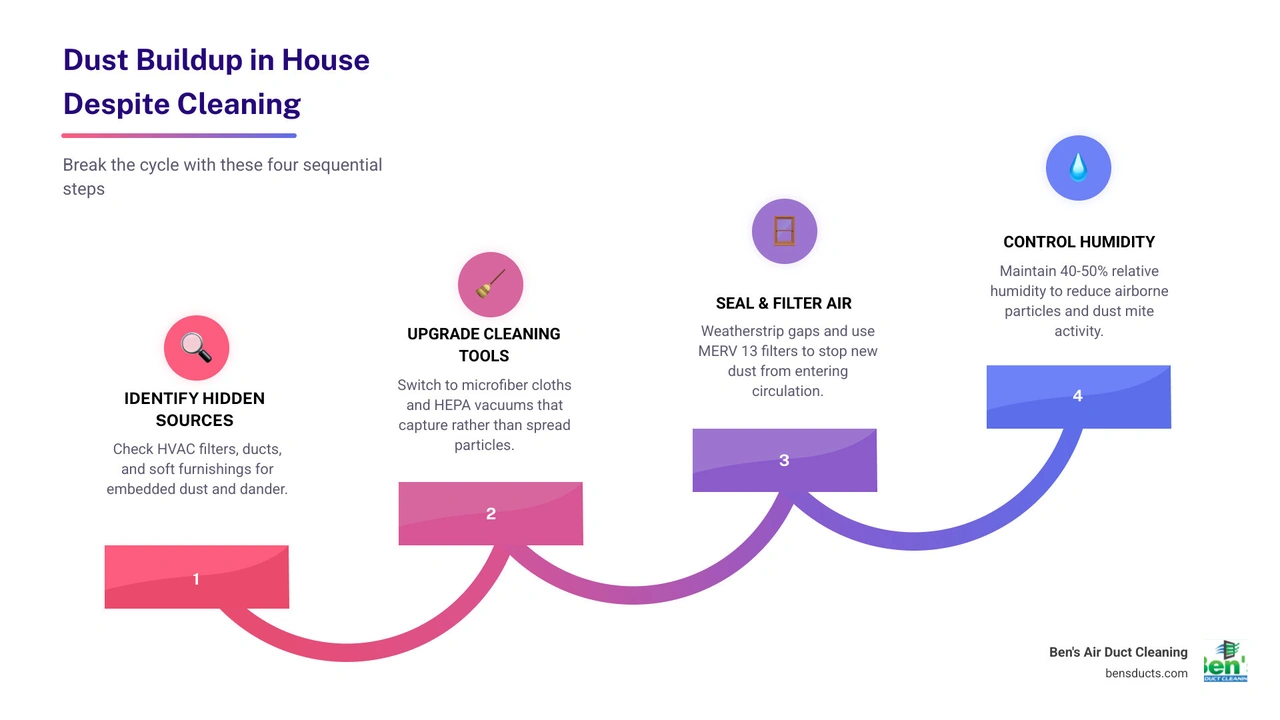
Dust buildup in house despite cleaning terms at a glance:
- how to check if your air ducts need cleaning
- musty smell from air vents causes
- visible dust around air vents what it means
Understanding Dust Buildup in House Despite Cleaning

To solve a problem, we first have to understand what we are actually fighting. Many people assume that household dust is simply dirt tracked in from the outdoors. While outdoor soil is certainly a component, the reality of what dust is made of might surprise you—and explain why it seems to generate out of thin air.
Household dust is a complex, microscopic cocktail. Its primary ingredients include:
- Human Skin Cells: Humans shed millions of dead skin cells every single day. In a closed indoor environment, these cells settle onto surfaces and become a primary food source for dust mites.
- Pet Dander and Hair: If you have furry family members, your dust load increases exponentially. Pets shed dander (dead skin flakes) and hair, which can increase the rate of dust accumulation by two to three times compared to pet-free homes.
- Textile Fibers: Microscopic fibers break off from your carpets, rugs, upholstered furniture, bedding, and clothing every time you move.
- Debris from Microorganisms: Dust mites, their waste products, and mold spores thrive in household environments. In fact, dust mites and their waste make up a significant portion of older dust deposits.
- Outdoor Infiltrators: Pollen, soil particles, and vehicle emissions sneak in through open windows, doors, and tiny gaps in your home's structure.
Because these sources are constantly active, dust generation never stops. When you clean surfaces, you are only addressing the dust that has already settled. If your home has a high rate of internal dust generation or poor filtration, you will experience Home Excessive Dust Despite Regular Cleaning.
Why Dust Returns Quickly: The Science of the Dust Feedback Loop
Have you ever noticed how dust seems to magically reappear on your TV screen or glass coffee table just hours after you wiped it clean? This is not your imagination; it is the result of a physical phenomenon known as the dust feedback loop.
When you clean, walk, or run the HVAC system, you stir up settled dust, launching millions of microscopic particles back into the air. In a typical indoor environment, these lightweight particles can remain suspended in the air for 20 minutes or longer. If your air circulation is poor, static electricity on electronic screens and smooth surfaces acts like a magnet, pulling these floating particles right back down. This continuous cycle of settling, getting kicked back into the air, and resettling is why many homeowners find themselves Addressing Dust Circulation Problems on a weekly basis.
How to Diagnose an Above-Average Dust Buildup in House Despite Cleaning
Every home has some dust—it is an unavoidable part of life. However, there is a clear line between normal accumulation and a systemic dust problem. You can diagnose whether your home has an above-average dust issue using two simple tests:
- The 24-Hour Finger Swipe Test: Thoroughly clean a dark, flat surface (like a wooden coffee table or shelf). Check it exactly 24 hours later. If you can clearly write your name in a thick layer of grey film within one day, your dust accumulation rate is abnormally high.
- The White Cloth Test: Place a clean white microfiber cloth on an undisturbed shelf or in an unused room. Leave it there for 7 to 10 days. If the cloth turns dark grey or is covered in a heavy, fuzzy layer of debris, your indoor air is carrying a heavy load of particulate matter.
If your home fails these tests, it is highly likely that your home's air systems or structural seals are compromised. This is one of the primary Signs Your Air Ducts Need Cleaning or that your HVAC filtration system is failing to do its job.
The Hidden Culprits: HVAC Systems and Leaky Ductwork
When surface cleaning fails to keep dust at bay, the root cause is almost always hidden behind your walls and ceilings. Your heating, ventilation, and air conditioning (HVAC) system acts as the "lungs" of your home. It pulls air in, conditions it (heats or cools it), and pushes it back out. If these "lungs" are dirty or damaged, they will act as a particle super-spreader, distributing dust evenly to every single room.
If you notice Visible Dust Around Air Vents What It Means is that your system is actively blowing accumulated debris back into your living spaces. In some cases, you might even see dark, soot-like stains around the registers, prompting questions about Why Vents Are Collecting Black Dust. This is a major warning sign that your ductwork is either heavily contaminated or pulling in unfiltered air from unconditioned spaces like your attic or crawlspace.
The Air Filter Problem and MERV Ratings
Your HVAC air filter is your home's first line of defense against airborne dust. However, many homeowners make the mistake of using cheap fiberglass filters or neglecting to change them on schedule.
Air filters are rated using the Minimum Efficiency Reporting Value (MERV) scale, which ranges from 1 to 16 for residential systems:
- Low MERV Ratings (1-4): These basic filters are designed primarily to protect the HVAC machinery from large debris. They do almost nothing to stop fine dust, pollen, or pet dander from recirculating through your home.
- Medium MERV Ratings (8-11): This is the sweet spot for most residential homes. A MERV 8 or 11 filter effectively captures dust, mold spores, pollen, and pet dander.
- High MERV Ratings (13+): These filters capture incredibly fine particles, including bacteria and smoke. However, they can restrict airflow in older HVAC systems, forcing the system to work harder and potentially causing damage.
If you do not replace your filter every 30 to 90 days—or if you use an undersized, low-quality filter—dust will bypass the filter entirely. Once this happens, the dust settles inside your furnace cabinet and blower fan, which then blows it directly into your rooms.
Leaky Ducts and Building Envelope Gaps
Even if you buy the best air filters on the market, they cannot protect your home if your ductwork is leaky. In a typical home, duct connections run through unconditioned, highly dusty spaces such as attics, basements, and crawlspaces.
When your HVAC blower fan turns on, it creates a powerful vacuum inside the return ducts. If there are gaps, cracks, or disconnected joints in these ducts, they will suck in dirty, dusty, and hot attic air. This unfiltered, contaminated air bypasses your HVAC filter entirely and is blown directly out of your supply vents.
Additionally, gaps in your home's building envelope (such as around window frames, doors, and attic hatches) pull in outdoor dust due to pressure differences. If you notice certain rooms are dustier and harder to keep comfortable, you may be dealing with Dirty Ductwork And Uneven Room Temperatures.
Environmental and Lifestyle Accelerators of Household Dust
While mechanical systems play a massive role, our daily habits and local environment also heavily influence how much dust settles in our homes.
- The Pet Factor: Our beloved dogs and cats are constant dust factories. Beyond shedding fur, they shed microscopic dander and track in outdoor dirt on their paws.
- The Foot Traffic Effect: Every time someone walks into your house wearing outdoor shoes, they bring in millions of microscopic soil particles, pollen grains, and asphalt dust. These particles settle deep into carpet fibers, only to be launched back into the air with every step you take.
Regional Factors: Why Dust Varies by Location
Dust is not the same everywhere. Depending on where you live in Ohio—whether you are near the lake in Avon Lake, in a leafy suburb like Westlake, or in a bustling area like Cleveland—the composition of your household dust will vary.
- Pollen Seasons: Northeast Ohio experiences heavy seasonal pollen spikes. Spring tree pollen and late-summer ragweed find their way indoors, settling as a fine yellowish-grey dust.
- Soil Composition: Areas with clay-heavy soils (common throughout Cuyahoga and Lorain counties) generate incredibly fine dust when dry. Once tracked indoors, this clay dust breaks down into ultra-fine particles that easily stay airborne.
- Local Construction: With ongoing suburban development in areas like Avon, North Ridgeville, and Strongsville, construction dust (including drywall dust, concrete particulate, and sawdust) can travel significant distances and enter nearby homes through open windows or HVAC intakes.
The Humidity Factor: Too Dry vs. Too Humid
Indoor humidity has a profound impact on how dust behaves.
- When It is Too Dry (Below 30% RH): Dry air (very common during Ohio winters when heating systems are running) strips moisture from dust particles. This makes them incredibly light, allowing them to remain suspended in the air for hours and spread evenly across every surface in your home.
- When It is Too Humid (Above 50% RH): High humidity makes dust particles heavy, causing them to settle quickly. While this might sound good, high humidity creates the perfect breeding ground for dust mites and mold. Dust mites thrive in warm, moist air, and their rapidly growing populations will quickly increase the biological dust load in your home.
- The Target Range: Keeping your home's relative humidity between 40% and 50% is ideal. This balance keeps dust from floating endlessly while preventing dust mite and mold populations from exploding.
How to Stop Dust Buildup in 5 Simple Steps
If you are tired of losing the war against dust, it is time to change your strategy. You cannot stop dust from being generated, but you can drastically limit how much of it accumulates on your furniture.
Follow these five simple steps to break the dust feedback loop:
- Clean in the Correct Order: Always work from top to bottom so gravity works with you, not against you.
- Upgrade Your Cleaning Tools: Ditch the feather dusters and dry rags for tools that actually trap and hold dust.
- Manage Soft Furnishings and Clutter: Reduce the fabric reservoirs that store and release dust.
- Seal Your Home's Envelope: Keep outdoor dust and attic air from sneaking inside.
- Optimize Indoor Humidity and Air Filtration: Control the movement of airborne particles.
Here is a quick comparison of why your choice of cleaning tools makes all the difference:
| Cleaning Tool | How It Works | The Result |
|---|---|---|
| Feather Duster / Dry Cloth | Knocks dust off surfaces and launches it into the air. | Dust settles back onto your furniture within hours. |
| Damp Microfiber Cloth | Uses tiny polyester/nylon fibers to grab, trap, and hold dust. | Dust is physically removed from the home. |
| Standard Vacuum | Pulls in dirt but blows fine dust out of the exhaust. | Redistributes fine particles throughout the room. |
| HEPA-Filtered Vacuum | Traps 99.97% of particles down to 0.3 microns. | Locks away fine dust, dander, and allergens safely. |
Step 1: Clean in the Correct Order
The golden rule of dust control is to always clean from top to bottom. Start by dusting high surfaces like ceiling fans, light fixtures, and the tops of cabinets. Any dust that escapes your cloth will fall onto lower surfaces or the floor.
Once you have finished dusting all surfaces, wait about 20 minutes (the "20-minute rule"). This allows any airborne dust that was stirred up during the process to settle onto the floor. Finally, vacuum your carpets and mop your hard floors to capture the fallen particles. If you vacuum first and dust second, you will simply coat your clean floors in a fresh layer of debris.
Step 2: Upgrade Your Cleaning Tools
Feather dusters are essentially dust redistribution devices. They look fancy, but they merely launch dust back into the air. Instead, switch to damp microfiber cloths. The microscopic fibers in microfiber carry a natural static charge that attracts dust, while the dampness ensures the particles stick to the cloth instead of floating away.
For tight spaces, electronics, or delicate items, use electrostatic dusters or clean, soft paintbrushes to trap dust before wiping down the surrounding area. When vacuuming, ensure your machine is equipped with a sealed HEPA filter so you aren't blowing fine dust straight out of the vacuum's exhaust.
Step 3: Manage Soft Furnishings and Clutter
Soft fabrics are massive dust reservoirs. Every time you sit on a fabric couch, close your curtains, or step on a rug, you release thousands of trapped fibers and skin cells into the air.
- Wash Bedding Weekly: Wash your sheets, pillowcases, and blankets in hot water (at least 130°F) weekly to kill dust mites and remove accumulated skin cells.
- Clean Window Coverings: Vacuum your curtains monthly using the brush attachment, and wipe down blinds bi-weekly.
- De-Clutter: Decorative knick-knacks, piles of paper, and open storage bins are major dust traps. Keep flat surfaces as clear as possible to make regular dusting quick and effective.
Step 4: Seal Your Home's Envelope
Keep outdoor dust from infiltrating your living spaces by sealing gaps in your home's exterior envelope:
- Use the Flashlight Test: At night, have someone stand outside an exterior door with a flashlight while you look from the inside. If you see light shining through the gaps, you need to replace your weatherstripping.
- Caulk Windows: Apply fresh exterior-grade caulk around drafty window frames.
- Seal the Attic Hatch: The attic hatch is a major source of dusty attic air intrusion. Use foam weatherstripping tape around the edges of the hatch to create a tight seal.
Step 5: Optimize Indoor Humidity and Air Filtration
Use technology to keep airborne dust under control:
- Maintain 40-50% Humidity: Use a humidifier during dry winter months and a dehumidifier or air conditioner during humid Ohio summers.
- Upgrade to MERV 8-11 Filters: Ensure your HVAC system is running a high-quality pleated filter, and change it every 60 to 90 days (or every 30 days if you have multiple pets).
- Deploy HEPA Air Purifiers: Place dedicated HEPA air purifiers in high-traffic rooms or bedrooms to continuously scrub dust from the air before it can settle.
Breaking the Cycle with Professional HVAC and Duct Maintenance
While DIY steps are incredibly effective at keeping daily dust levels down, they cannot solve a systemic dust issue. If your air ducts are lined with years of accumulated dust, pet dander, construction debris, and mold spores, your HVAC system will continue to blow these contaminants into your home every time the fan kicks on.
This is where professional maintenance becomes essential. Investing in Removing Air Duct Contaminant Buildup is the only way to reset your home's baseline and stop the endless cycle of cleaning. When done correctly, Air Duct Cleaning Improves Homes Air quality dramatically, making your daily cleaning efforts much more effective and long-lasting.
When Professional Help is Needed for Dust Buildup in House Despite Cleaning
If you are cleaning constantly and still dealing with rapid dust accumulation, it is time to bring in the pros. We generally recommend having your air ducts inspected and cleaned every 3 to 5 years. However, you should consider scheduling a service sooner if you experience any of the following:
- Persistent Allergy Symptoms: If your family struggles with unexplained sneezing, coughing, or itchy eyes while indoors, it is a clear sign of poor indoor air quality. Understanding How Dirty Air Ducts Affect Your Health is crucial for protecting your loved ones from airborne triggers.
- Musty Odors from Vents: A damp, stale smell when your AC or heat turns on indicates potential mold or mildew growth inside your ductwork. This means Dirty Air Ducts Are Compromising Home safety and comfort.
- Recent Renovations: Drywall dust and construction debris easily bypass standard filters and settle deep inside your ducts, causing ongoing dust issues long after the contractors have left.
At Ben's Air Duct Cleaning, our NADCA-certified team uses advanced, truck-mounted vacuum systems and specialized agitation tools to thoroughly clean your entire duct system—ensuring that dust is completely removed from your home, not just shifted around.
Frequently Asked Questions about Household Dust
Why does my house get dusty so fast?
A house that accumulates dust rapidly is usually dealing with a combination of high internal generation (from pets, carpeted floors, and daily activity) and poor air filtration. If your HVAC filter is dirty, or if you have leaky ductwork pulling in dusty attic air, the particles are constantly recirculated instead of being captured.
Do air purifiers actually reduce dust?
Yes, high-quality air purifiers equipped with true HEPA filters are highly effective at capturing airborne dust. They work by continuously pulling room air through a dense filter, trapping 99.97% of particles. While they cannot clean dust that has already settled on your furniture, they drastically reduce the amount of floating dust that eventually lands on your surfaces.
How often should I have my air ducts cleaned?
For most homes in Northeast Ohio, a professional duct cleaning is recommended every 3 to 5 years. However, you may need more frequent cleanings if you have multiple shedding pets, family members with severe asthma or allergies, or if you have recently completed a major home renovation project.
Conclusion
Succeeding in the battle against dust buildup in house despite cleaning requires moving past surface-level wiping and addressing the systemic issues that keep dust circulating. By upgrading your cleaning tools, maintaining proper indoor humidity, and sealing up leaks, you can drastically reduce the daily dust load in your home.
When DIY efforts aren't enough to break the cycle, we are here to help. Ben's Air Duct Cleaning provides expert, NADCA-certified air duct and dryer vent cleaning services to homeowners throughout Northeast Ohio, including Cleveland, Avon Lake, Westlake, Elyria, Strongsville, and the surrounding areas. Our highly trained team uses state-of-the-art equipment to remove deep-seated contaminants, restoring your HVAC system's efficiency and giving your family the clean, fresh air they deserve.
Ready to clear the air in your home? Explore our professional Indoor Air Quality Services and schedule your system inspection today!
Free quotes · 4.9★ on Google
Breathe easier. Get your free quote today.
Call now or request a free quote online — the Ben's team serves Northeast Ohio with licensed, insured, background-checked technicians.
No-pressure pricing · Before & after photos every job · 36 Ohio cities