
Learning Center
How Often Should Allergy Sufferers Clean Their Ducts?
Discover how often allergy sufferers should clean their ducts to reduce allergens and improve indoor air quality with professional NADCA-certified service.
By Bachar “Ben” El Halabi Published Updated
Your Ducts Could Be Making Your Allergies Worse — Here's How Often to Clean Them
Knowing how often should allergy sufferers clean their ducts is one of the most practical steps you can take toward breathing easier at home. If you or someone in your household deals with sneezing, congestion, itchy eyes, or asthma flare-ups indoors, your air ducts may be a bigger part of the problem than you realize. According to the EPA, indoor air can be 2 to 5 times more polluted than outdoor air — and your duct system is one of the main reasons why.
Here is a quick answer based on NADCA guidelines and expert recommendations:
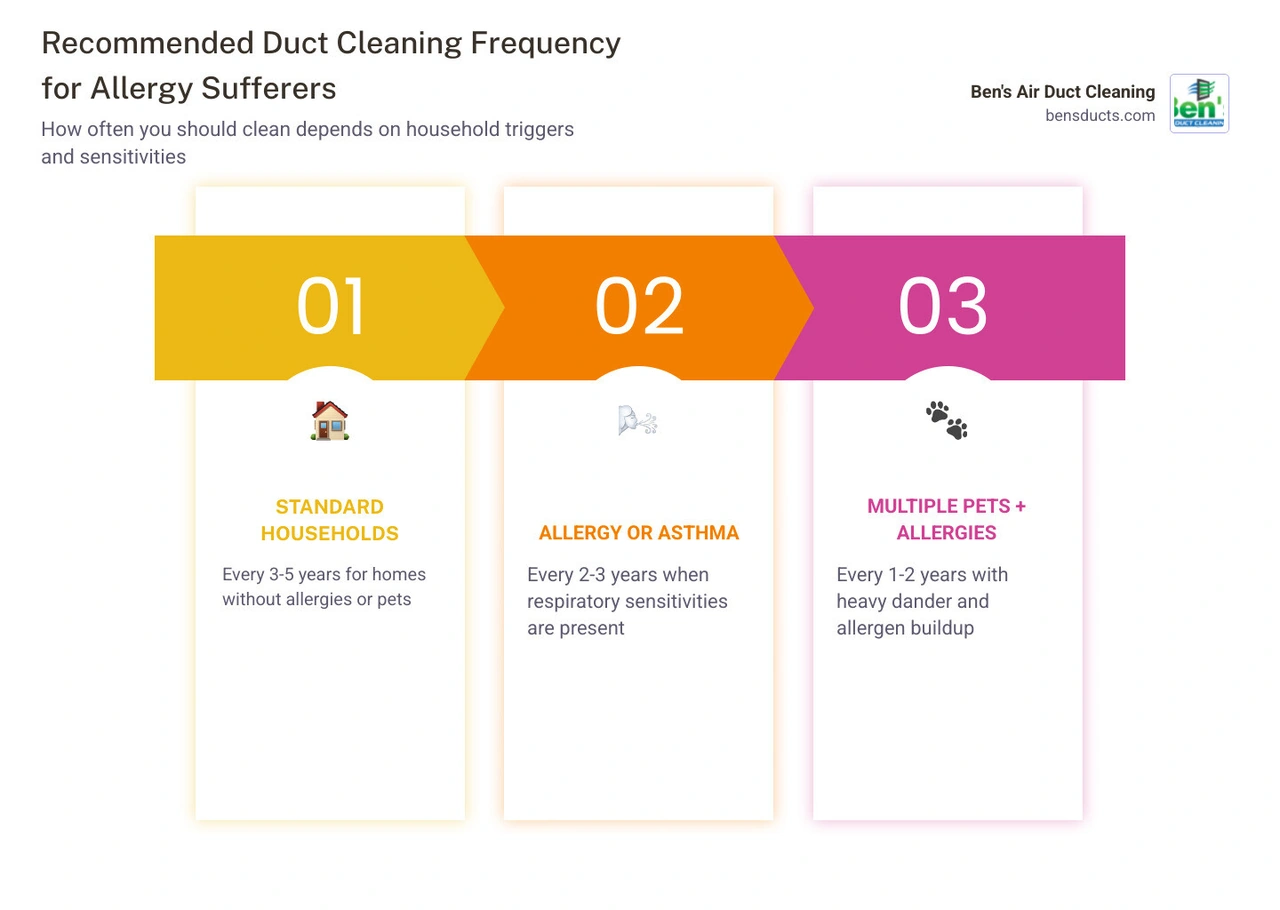
Recommended Duct Cleaning Frequency for Allergy Sufferers
| Household Situation | Recommended Cleaning Frequency |
|---|---|
| No pets, no allergies (general guideline) | Every 3 to 5 years |
| Allergy or asthma sufferers | Every 2 to 3 years |
| Allergy sufferers with one or more pets | Every 2 years |
| Multiple shedding pets, severe allergies | Every 1 to 2 years |
| After renovation, mold discovery, or pest infestation | Immediately |
Every time your HVAC system runs, air passes through your ducts and carries whatever has built up inside — dust mites, pollen, pet dander, and mold spores — directly into the rooms where you live and breathe. For most households, that is manageable with routine cleaning every few years. But for allergy sufferers, that buildup triggers real symptoms, and the standard timeline simply does not apply.
At Ben's Air Duct Cleaning, our NADCA-certified team serves homeowners across the Cleveland, Ohio area — including Berea, Westlake, Strongsville, Parma, and surrounding communities — helping families reduce indoor allergens with professional duct cleaning built around your specific situation.
How Often Should Allergy Sufferers Clean Their Ducts?
While the National Air Duct Cleaners Association (NADCA) recommends a general duct inspection every year and a thorough cleaning every 3 to 5 years for a typical home, this timeline changes dramatically when respiratory sensitivities enter the equation. For those dealing with persistent symptoms, how often should allergy sufferers clean their ducts becomes a question of health rather than simple home maintenance.
For allergy sufferers, cleaning air ducts every 2 to 3 years is recommended to prevent worsening symptoms. Over this period, a significant amount of allergen buildup accumulates along the interior walls of your ductwork. Because your heating and cooling system acts like the lungs of your home, it pulls in air from your living space, conditions it, and pushes it back out. If the pathways are coated in fine particulates, those allergens are constantly recirculated.
When you consult standard industry resources, such as our guide on How Often Should You Have Your Air Ducts Cleaned, you will find that the EPA takes a cautious, "as-needed" stance on duct cleaning. The EPA does not recommend routine annual cleaning for healthy, symptom-free households. However, both the EPA and NADCA agree that when occupants suffer from allergies, asthma, or other respiratory conditions, reducing the overall reservoir of airborne irritants in the home is a highly logical step. By keeping your system clean on a 2-to-3-year cycle, you prevent the massive accumulation of dust and biological triggers that standard filters cannot entirely stop.
Why standard timelines change for sensitive households
If you have ever wondered why some people can live in a dusty house without a single sneeze while others react to the slightest airborne speck, it all comes down to immune response and dust sensitivity. For individuals with robust respiratory health, minor particulates in the air are easily filtered by the body's natural defenses. But for sensitive households, even micro-levels of dust and dander trigger an overactive immune response, leading to chronic inflammation, sinus pressure, and asthma attacks.
This is why specialized Air Duct Cleaning for Allergy and Asthma Sufferers is so critical. Standard timelines assume a "best-case scenario" household with no respiratory illnesses, no pets, and mild local weather. When you introduce a diagnosed allergy or asthma sufferer to the home, the threshold for comfort drops significantly. A layer of dust that seems harmless to a general contractor can be a daily source of misery for a sensitive child or adult. Regular cleaning breaks the cycle of particulate resuspension, keeping the baseline of indoor irritants below the threshold that triggers a physical reaction.
Environmental factors affecting how often should allergy sufferers clean their ducts in Ohio
Living in the Great Lakes region brings unique environmental factors that directly impact your indoor air quality. In northeastern Ohio communities like Cleveland, Lakewood, Avon Lake, and Elyria, our weather swings from freezing, snowy winters to hot, incredibly humid summers. This seasonal volatility plays a massive role in how quickly contaminants build up inside your ventilation system.
During our sticky Ohio summers, high indoor humidity levels can cause condensation to form on the cool metal surfaces of your ductwork. When moisture meets the organic dust already resting inside the vents, it creates an ideal breeding ground for mold growth. Additionally, the spring and summer seasons bring heavy blankets of tree, grass, and weed pollen.
As we discuss in our breakdown of Ductwork and Indoor Air Pollution Sources, these outdoor allergens are pulled into your home through open windows, doors, and shoes, eventually settling deep inside your HVAC system. When winter arrives and we seal our homes tight against the cold in suburbs like Strongsville and North Royalton, we end up recirculating that trapped pollen and mold for months on end. Because of this Great Lakes climate dynamic, Ohio allergy sufferers often find that a strict 2-year cleaning cycle is necessary to keep seasonal flare-ups under control.
Key Triggers and Contaminants Hiding in Your Ventilation System

To understand why clean ducts matter so much, we have to look at what is actually living and collecting inside them. Your ductwork is a dark, undisturbed environment, making it a perfect sanctuary for several common indoor allergens.
The primary culprits hiding in your system include:
- Dust Mites: These microscopic pests do not feed on your ducts; they feed on the dead skin cells that make up a large portion of household dust. The microscopic waste they leave behind is one of the most potent allergy triggers in the world.
- Pet Dander: Tiny, microscopic flecks of skin shed by cats, dogs, and other animals. Because dander is incredibly light and sticky, it easily bypasses standard air filters and clings to duct walls.
- Mold Spores: When humidity rises, mold spores germinate inside the ducts. Every time the blower motor kicks on, millions of invisible spores are launched into your breathing air.
- Pollen Grains: Heavy outdoor pollen seasons deposit fine yellow and green dust inside your system. This pollen can remain trapped in your ducts for months, causing "seasonal" allergy symptoms long after the outdoor pollen count has dropped.
- Volatile Organic Compounds (VOCs): Dirty ducts can hold up to 30% more volatile organic compounds (VOCs) than clean ones. These chemical vapors from household cleaners, paints, and plastics cling to dust particles inside your vents and slowly off-gas into your home.
For a deeper dive into these hidden irritants, check out our guide on Indoor Allergy Triggers Hiding in Your Air Ducts.
The connection between dirty ducts and respiratory symptoms
It is a well-established fact in the medical community that poor indoor air quality directly correlates with physical illness. Around 60% of allergy sufferers report that their symptoms worsen when they spend time in spaces with poor indoor air quality. When your ventilation system is dirty, it acts as a constant distribution mechanism for airborne irritants.
Every time the furnace or air conditioner starts up, a burst of fine particulates is pushed into your rooms. This creates a direct Dirty Ductwork and Allergy Symptoms Connection, leading to symptoms like:
- Continuous sneezing and dry coughing
- Itchy, watery, or bloodshot eyes
- Chronic sinus congestion and post-nasal drip
- Unexplained headaches and fatigue, especially in the mornings
- Severe asthma triggers and wheezing
Understanding How Dirty Air Ducts Affect Your Health helps explain why simply taking allergy medication is often not enough. If the air you breathe for eight hours every night is filled with resuspended triggers, your body remains in a constant state of low-grade respiratory stress. Removing the reservoir of these irritants at the source is key to finding lasting relief.
How often should allergy sufferers clean their ducts when they have shedding pets?
If you share your home with furry family members, your duct cleaning timeline needs to be accelerated. Pets constantly shed hair and dander, which gets sucked directly into your return air vents. Over time, this creates a thick, felt-like layer of fur and dander along the interior of your ductwork.
This accumulation leads to rapid filter clogging and creates a rich food source for dust mites. To combat this, we recommend that allergy sufferers with shedding pets move to a strict 2-year cleaning cycle. If you have multiple high-shedding breeds (like Huskies, Golden Retrievers, or long-haired cats), an annual inspection is highly recommended. By staying ahead of the dander buildup, you can successfully Eliminate Allergens Trapped in Air Ducts and keep your home's air feeling fresh and clean.
Signs your HVAC system needs immediate cleaning for allergy relief
You do not always have to wait for the calendar to tell you when it is time to clean your vents. Your home and your body will often give you clear warning signs.
According to our guide on Signs Your Air Ducts Need Cleaning, you should schedule a professional service immediately if you notice any of the following:
- Musty Odors: A stale, damp, or moldy smell coming from your registers when the air turns on is a major indicator of biological growth in the system.
- Visible Mold: If you see black, green, or white fuzzy spots on your vent covers or inside the register boots.
- Post-Renovation Dust: Home remodeling projects create massive amounts of drywall dust (gypsum) and concrete dust (silica). This fine, abrasive dust easily bypasses filters and settles in your ducts, irritating lungs for months after the contractors leave.
- Pest Infestations: If you have recently dealt with mice, rats, squirrels, or insects, they leave behind droppings, nesting materials, and pheromones that ruin indoor air quality.
- Register Dust: If you notice dark, dusty rings forming on the ceiling or walls around your supply registers, or if a thick layer of dust puff out when the system starts.
Professional Source Removal vs. DIY Duct Cleaning
When it comes to removing allergens from your home, there is a massive difference between a superficial DIY cleaning and a professional source removal process. Many homeowners attempt to clean their own vents using shop vacuums or retail duct brush kits, but these methods often end up making indoor air quality worse.
True allergen reduction requires professional-grade equipment. At Ben's Air Duct Cleaning, we use high-powered truck-mounted vacuum systems that establish a powerful negative pressure throughout your entire duct system. While the system is under negative pressure, we use specialized mechanical agitation tools — such as air whips, rotary brushes, and skipper nozzles — to dislodge stuck-on dust, dander, and debris from the duct walls. Because the system is under a vacuum, all the dislodged contaminants are pulled directly out of your home and into our truck-mounted HEPA filtration system, preventing any dust from escaping into your living rooms.
To understand the difference, consider how our professional process plays a key role in Air Duct Cleaning in Allergy Prevention compared to typical DIY attempts:
| Feature / Capability | Professional Source Removal (Ben's Ducts) | DIY Vent Vacuuming |
|---|---|---|
| Vacuum Power | High-powered negative pressure (truck-mounted) | Standard household or shop vacuum suction |
| Agitation Tools | Pneumatic whips and rotary brushes | Handheld manual brushes or basic wire snakes |
| Dust Containment | 100% contained; pulled directly out of the home | High risk of loose dust blowing back into rooms |
| Allergen Filtration | Medical-grade HEPA filtration | Standard cartridge filters (allows fine dust bypass) |
| System Reach | Cleans 100% of supply, return, and trunk lines | Only reaches the first 5 to 10 feet of vents |
| Risk of Damage | None (performed by licensed, insured experts) | High risk of tearing flexible ductwork |
Why retail vacuum kits fall short for allergen removal
Store-bought duct cleaning kits and standard household shop vacuums simply do not possess the power or filtration required to handle fine allergens. When you stick a standard vacuum hose down a vent, you can only reach the first few feet. More importantly, household vacuums lack the negative pressure capacity to keep dust from traveling.
As you brush the duct walls, you stir up years of settled particulates. Without a powerful truck-mounted vacuum pulling that dust away, the loose dust simply suspends in the air. The moment you turn your furnace back on, a massive cloud of allergens bypasses your system and lands on your furniture, carpets, and directly into your lungs.
Furthermore, standard shop vacuums suffer from "particle bypass." Their filters are not fine enough to trap microscopic mold spores and pet dander, meaning the vacuum actually acts as an allergen aerosolizer, blowing the smallest, most irritating particles right out of its exhaust and into your room. Attempting to DIY clean your ducts can also cause expensive damage to flexible ductwork or loosen joint seals, which lowers your system's static pressure and strains the blower motor.
Best practices to reduce the need for frequent cleanings
While regular professional cleaning is essential for allergy sufferers, there are several proactive steps you can take to keep your system cleaner for longer. Implementing a few smart home habits will protect your respiratory health and extend the time between your professional duct cleanings.
According to our guide on the Best Indoor Air Quality Practices for Allergy Sufferers, we recommend focusing on these core areas:
- Upgrade Your HVAC Filters: Ditch the cheap, see-through fiberglass filters. Upgrade to a high-quality pleated filter with a MERV (Minimum Efficiency Reporting Value) rating of 11 to 13. These filters are highly efficient at capturing pet dander, mold spores, and pollen before they can enter your ductwork. Just be sure to change them every 60 to 90 days.
- Control Indoor Humidity: Keep your home's relative humidity between 30% and 50%. This range is low enough to prevent mold growth and stop dust mites from breeding, but high enough to keep your respiratory passages comfortable.
- Practice Regular Dusting and Vacuuming: Dust your home weekly using damp microfiber cloths (which trap dust rather than scattering it) and vacuum your carpets with a HEPA-filtered vacuum cleaner.
- Schedule Annual HVAC Maintenance: Having a professional clean your air conditioner's evaporator coils and your furnace's blower motor prevents dust from accumulating on the mechanical parts of your system, which keeps your air cleaner and your utility bills lower.
Frequently Asked Questions about Duct Cleaning and Allergies
Does duct cleaning actually prevent health problems?
The scientific consensus, including the stance of the EPA, is that routine duct cleaning has never been shown to actively prevent health problems in a general, healthy population. However, for individuals who have pre-existing respiratory conditions like allergies, asthma, or severe dust sensitivities, removing the massive reservoir of airborne triggers from the home's ventilation system has been shown to provide significant, common-sense symptom relief. Regular air duct cleaning can reduce overall indoor contaminants by around 30%, which directly lowers the daily allergen load your body has to fight.
How long does a professional duct cleaning service take?
For a standard single-family home in the Cleveland area, a thorough, professional air duct cleaning typically takes between 2 to 4 hours. The exact duration depends on several factors, including the total square footage of your home, the number of furnace systems, the accessibility of your ductwork, and how much debris has accumulated since your last cleaning. Our team at Ben's Air Duct Cleaning takes the time to inspect and clean every single supply and return register, as well as the main trunk lines, to ensure a complete job.
Can dirty air ducts increase my home's energy bills?
Yes, absolutely. When dust, pet hair, and debris build up inside your ventilation system, they create physical airflow restriction. This forces your furnace and air conditioner to work much harder to push air throughout your home, putting extra strain on the blower motor and reducing overall system efficiency. Additionally, if dust coats your system's heating and cooling coils, it acts as an insulator, making it harder for the system to condition the air. Getting your ducts cleaned can restore proper airflow and provide a noticeable boost to your HVAC system's efficiency, helping to keep your monthly utility bills in check.
Conclusion
Managing your indoor air quality is a key part of keeping your seasonal and year-round allergies under control. For sensitive households, knowing how often should allergy sufferers clean their ducts — and sticking to a reliable 2-to-3-year schedule — can make a world of difference in how you feel every single day.
At Ben's Air Duct Cleaning, we are proud to be the trusted, NADCA-certified experts serving homeowners throughout the greater Cleveland, Ohio region. From Lakewood and Westlake to Strongsville, Parma, and Berea, our licensed and insured team is committed to providing thorough, professional source removal services that help your family breathe easier.
Don't let dirty vents keep you sneezing in your own home. Schedule professional residential air duct cleaning today with the friendly team at Ben's Air Duct Cleaning and take your first step toward a cleaner, healthier indoor environment!
Free quotes · 4.9★ on Google
Breathe easier. Get your free quote today.
Call now or request a free quote online — the Ben's team serves Northeast Ohio with licensed, insured, background-checked technicians.
No-pressure pricing · Before & after photos every job · 36 Ohio cities